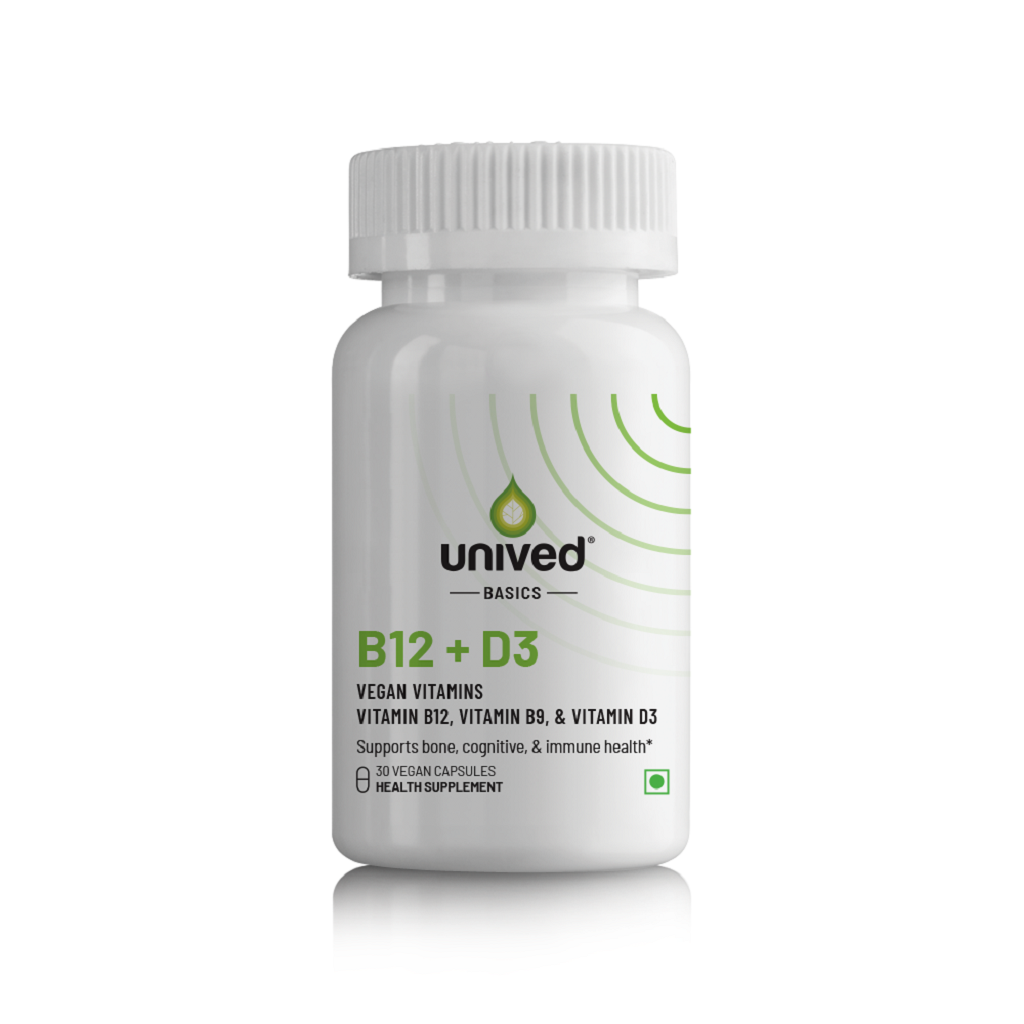
What's the difference between Basics B12 + D3 and Basics B12 + Folate?
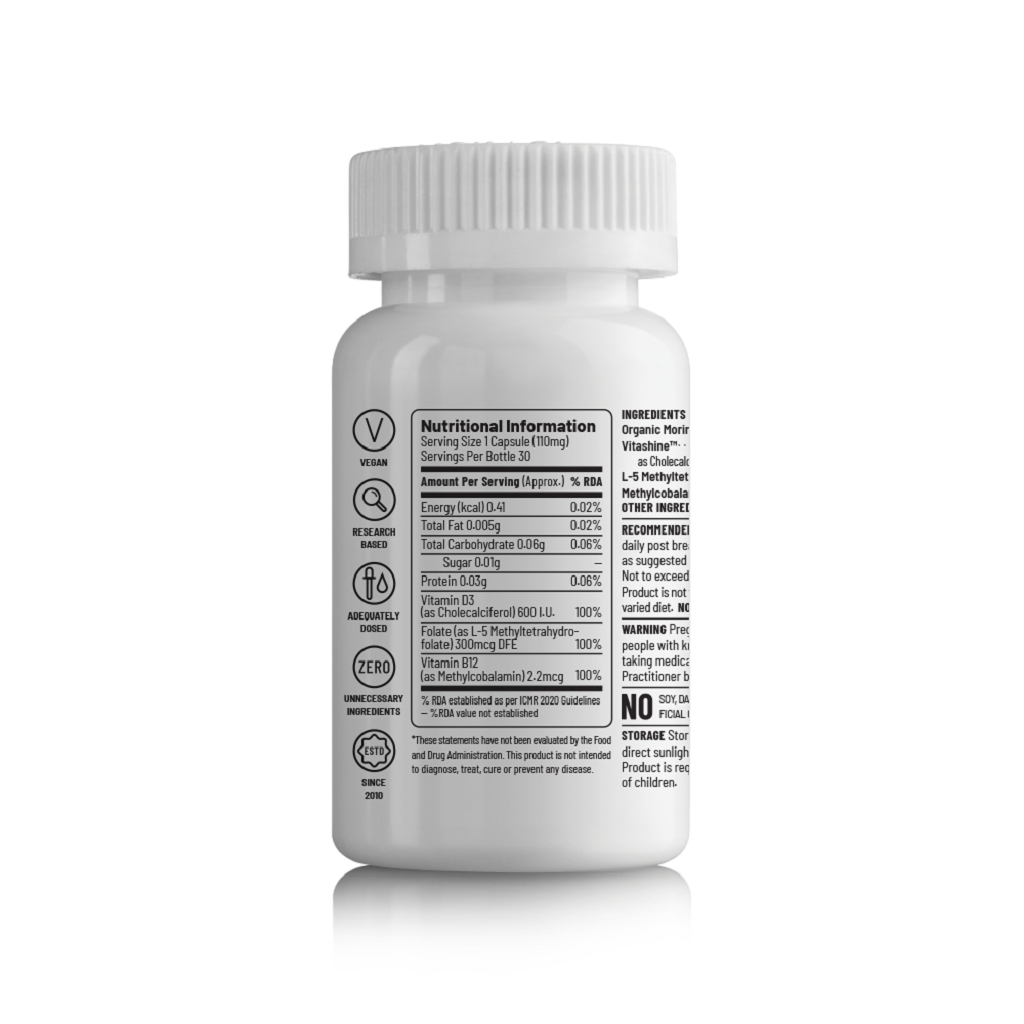
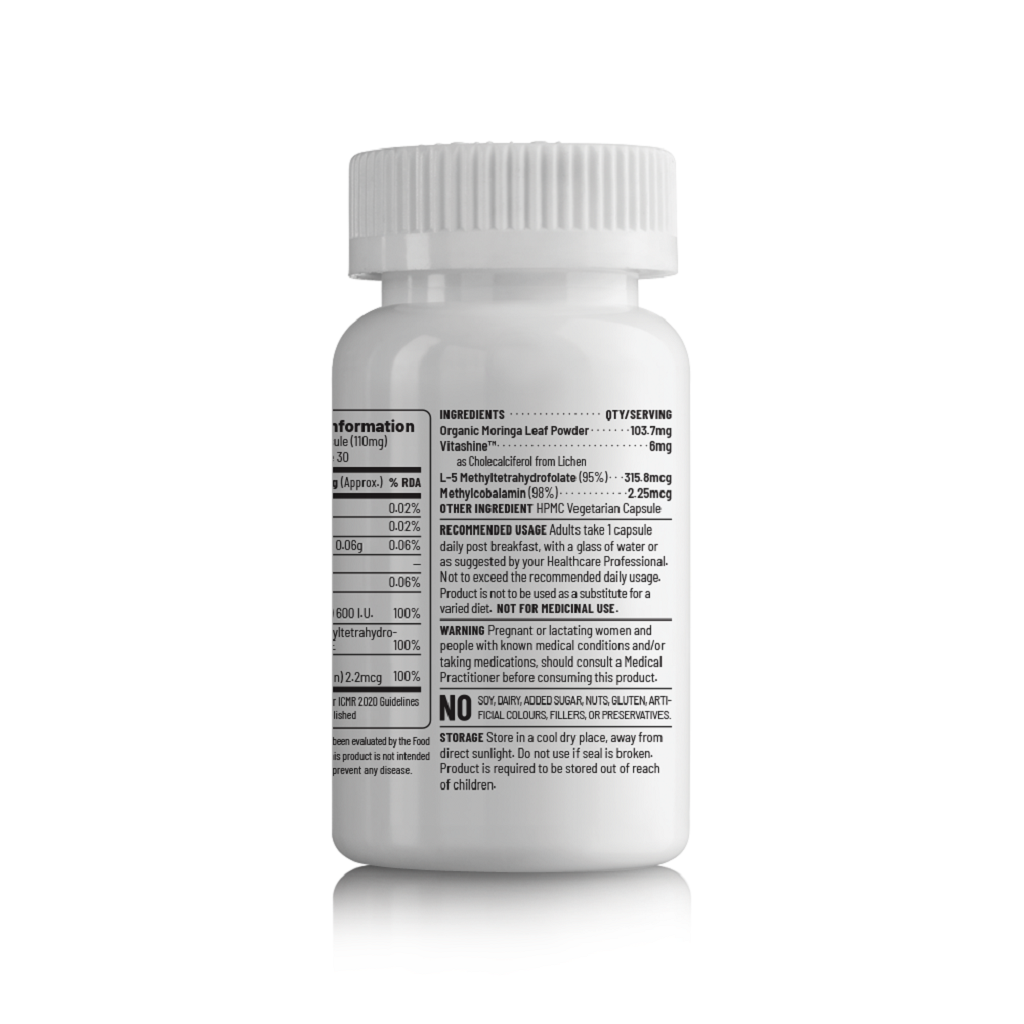
Both have the same B12 (2.2mcg methylcobalamin) and folate (300mcg DFE L-5-MTHF) at 100% RDA, with an organic Moringa Leaf Powder whole-food base. The difference is the third nutrient. This product (B12 + D3) includes 600 IU of Vitashine™ Vitamin D3 — for adults who want B12, folate, and D3 in one capsule. Basics B12 + Folate omits the D3 — for adults who handle their Vitamin D separately, don't need D3 supplementation (already adequate from sun exposure or other supplements), or prefer the simpler formulation. Choose B12 + D3 if you want all three core vegan-relevant nutrients in one capsule; choose B12 + Folate if you handle D3 elsewhere.
What's the difference between Basics B12 + D3 and the standard 180-cap B12 + D3?
Same formulation, different pack sizes and commitment levels. Both contain methylcobalamin B12 (2.2mcg, 100% RDA), L-5-MTHF folate (300mcg DFE, 100% RDA), Vitashine™ D3 (600 IU, 100% RDA), and organic moringa leaf powder. Basics B12 + D3 (30 capsules) is the entry-level pack — for adults trying daily supplementation for the first time, or who want to commit one month at a time. The 180-cap pack is for adults who have decided this is a long-term daily habit and want a 6-month supply at a lower per-capsule cost.
Why methylcobalamin instead of cyanocobalamin?
Cyanocobalamin is the cheapest, most shelf-stable form of B12 — it's what most multivitamins use. The body has to convert it into methylcobalamin (the active form) before it can be used. Most healthy adults convert efficiently; older adults, smokers, and people with certain genetic variants don't convert as well. Methylcobalamin is the form your body actually uses — supplementing it directly skips the conversion step. It also crosses the blood-brain barrier more readily, which matters for adults specifically supporting neurological function.
Why L-5-MTHF instead of folic acid?
Same logic as B12. Folic acid is the cheap synthetic form found in most fortified foods and supplements; the body has to convert it through the MTHFR enzyme. Up to 40% of populations carry MTHFR gene variants (C677T or A1298C) that limit conversion efficiency. These individuals get less benefit from folic acid and may even accumulate unmetabolised folic acid in their bloodstream. L-5-MTHF is the form the body uses directly — bypasses the conversion step entirely. Particularly relevant for women planning pregnancy, adults with known MTHFR variants, and anyone on long-term folic acid supplementation who hasn't seen the benefit expected.
Why is the Vitamin D3 from a plant source?
Most Vitamin D3 (cholecalciferol) on the market is extracted from lanolin (sheep's wool oil) — not vegan. Vitashine™ is plant-source cholecalciferol, fully vegan. Molecularly identical to lanolin-derived D3, with the same bioavailability and clinical effect. The form on the molecule level doesn't change; the source does. Worth the choice for vegans and for anyone who prefers plant-source supplementation.
What does Basics mean — is this lower quality than the standard range?
No. Basics is Unived's entry-level pack-size range — same ingredient quality, same active forms, same patented inputs, smaller pack for lower upfront commitment. The active forms (methylcobalamin, L-5-MTHF, Vitashine™ D3) are preserved at the Basics tier. The choice between Basics and the standard range is about pack size and per-capsule economics, not formulation quality. Most "entry-level" supplements in the market downgrade form (cyanocobalamin instead of methylcobalamin, folic acid instead of L-5-MTHF, lanolin-source D3 instead of plant-source) to hit a lower price. Unived Basics preserves the forms and reduces pack size instead.
Is the D3 dose enough on its own?
For maintenance, yes — 600 IU is the Indian RDA for adults. For correction of documented deficiency, no — your physician may recommend a higher therapeutic dose (typically 2,000–5,000 IU daily for several weeks, or 60,000 IU weekly) until your 25-OH Vitamin D blood level normalises, then stepping down to a maintenance dose like this product provides. The 600 IU dose is not "low" — it's "calibrated to maintain," which is what most adults need most of the time.
Why is there no K2-7 in this product?
K2-7 isn't in this product because the formulation is calibrated for the three nutrients most commonly under-supplied in vegan diets — B12, folate, and D3. K2-7 is a separate product (D3 + K2-7) for adults who specifically want K2 alongside their D3. The two products serve different priorities: B12 + D3 covers the three vegan-essential nutrients; D3 + K2-7 covers the D3 + K2 bone and arterial-health pairing.
What is moringa, and why is it in this product?
Moringa (Moringa oleifera) is a leaf vegetable recognised in traditional Indian nutritional medicine — known as sahjan or drumstick in many Indian households. The leaf powder is a whole-food nutrient base containing additional B-vitamins, vitamins A, C, E, and K, iron, calcium, magnesium, and a complete amino acid profile. The 103.7mg dose is modest — it's not a high-dose moringa supplement — but it anchors the product in a whole-food tradition rather than positioning it as a purely synthetic formulation. The synthetic B12, folate, and D3 doses still deliver the targeted nutritional support; the moringa adds whole-food context.
Can I take this if I'm on metformin?
Yes — and many physicians actively recommend B12 supplementation for long-term metformin users. Metformin depletes B12 over time through reduced absorption from food, and B12 deficiency is a recognised side effect of multi-year metformin use. The 2.2mcg daily dose helps offset that depletion. The D3 and folate are also unaffected by metformin. Mention to your physician as supportive information; no interaction with diabetes management.