Injury & Joint Collection

Joints carry you build them like they do

Athletes don't get injured in the session. They get injured in the slow accumulation of load on connective tissue that hasn't kept pace. Four formulations built around the two ways supplementation can actually help: managing the inflammation that already exists, and building the structural resilience that prevents the next problem.

  • Formulations
  • 2 Approaches
  • 100% Batch Tested
  • 0 Proprietary Blends
Injury & Joint

"The joint that holds up at year ten was built at year one. Recovery supplements don't fix old training. They protect the next decade."

— Unived Formulation Standard

✓ Third-party tested ✓ COA published ✓ No proprietary blends ✓ 100% vegan ✓ FSSAI compliant

4 products

Evidence Standard

Why we publish our evidence grades

Every product in the Sports range carries a published evidence grade — High, Moderate, or Emerging — based on the available RCT literature. We publish evidence grades even when they're Moderate, because honesty about what the science does and doesn't show is more valuable than inflated confidence.

Our Evidence Standard →

Common Questions

Sports nutrition questions, answered.

  • Aren't injuries about training load — what does supplementation actually do? Most injuries are training-load mismatches, and no supplement compensates for ramping volume too fast, training under-recovered, or skipping mobility work. What supplementation can do is support the underlying systems that absorb training load: connective tissue synthesis (Collagen Builder), bone mineralisation (CalDveg, D3K2), and inflammation resolution (Colox). Think of it as supporting infrastructure, not as injury prevention in any direct sense.
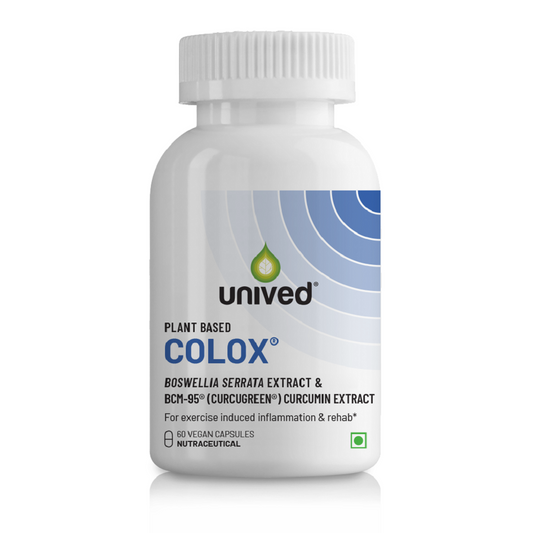
  • What does Colox actually do, and how is it different from regular curcumin? Colox combines BCM-95®, a patented curcumin extract with 7–10× higher bioavailability than standard curcumin (most curcumin is poorly absorbed without bioavailability enhancement), with Boswellia, a botanical with independent evidence for AKBA-mediated inflammation pathways. Both target inflammation through different mechanisms, which is why they're formulated together. It's the formulation we use when inflammation is already present — after high training loads, during flares, or alongside acute injury recovery — not as a daily preventive.
  • Do I need both CalDveg and D3K2? They both contain D3 and K2. Usually you'll take one or the other, not both. CalDveg is the full bone-mineral matrix — calcium, D3, K2, magnesium — for athletes specifically targeting bone density, recovering from a stress fracture, or for older adults building bone-mineral reserves. D3K2 is the everyday formulation at Indian RDA levels, for general bone and immune support without the calcium load. If you're already eating a calcium-rich diet (dairy, leafy greens, fortified foods), D3K2 covers what most Indian diets miss. If you're in a high bone-stress sport (running, jumping, contact) or have reason to support bone density actively, CalDveg is the more complete choice.
  • Why is K2 important, and what happens if I take calcium without it? Vitamin K2 activates the proteins that direct calcium into bone tissue rather than into soft tissue like arteries and joints. Calcium supplementation without K2 has been associated in some studies with arterial calcification — the calcium goes somewhere, and without K2 telling it where, it doesn't always go where you want. Both CalDveg and D3K2 include K2 specifically to prevent this. If you're already supplementing calcium from another source, ensure K2 is included.
  • What is Collagen Builder, and is it the same as collagen peptides? Collagen Builder supports your body's own collagen synthesis — the cofactors and substrates needed to build connective tissue — rather than supplying pre-formed collagen peptides. The choice between supporting endogenous synthesis vs. supplementing peptides depends on your goal: synthesis support is generally adequate for healthy active adults, while collagen peptides are sometimes preferred for specific tendon-rehabilitation protocols where higher peptide doses are used alongside structured loading.
  • Can I take Colox daily, or only when I'm sore or recovering from an injury? Both approaches are valid but serve different purposes. Daily use of Colox during heavy training blocks supports baseline inflammation management and is reasonable for athletes in high training loads. Targeted use during acute soreness or post-session inflammation works on a session-by-session basis. The argument against daily indefinite use: inflammation is also a signal — chronically suppressing it can mask issues that should be addressed by adjusting training rather than supplementation. Use Colox to support, not to obscure.
  • I have a tendon injury. Will Collagen Builder fix it? Collagen Builder supports the substrates your body uses to repair tendon tissue. It does not "fix" injuries — repair happens through the structured loading protocols your physiotherapist or sports medicine practitioner prescribes. If you're recovering from a tendon issue, the supplementation supports the work; the work is the loading programme. Take Collagen Builder consistently for 8–12 weeks alongside your rehabilitation, not as a substitute for it.
  • What's the right way to dose D3 if I'm in India and get sun exposure? Despite year-round sun, vitamin D deficiency is widespread in Indian adults — studies consistently report 70–90% insufficiency in urban populations, including athletes who train outdoors. The reasons: melanin reduces skin synthesis, training is often in early morning or evening (low UVB), and indoor lifestyles dominate. D3K2 at Indian RDA covers maintenance for most adults. If you have a documented deficit (a 25-OH vitamin D test below 30 ng/mL), the maintenance dose is insufficient — speak to your physician about a corrective protocol before relying on RDA-level supplementation.
  • Are these products WADA-compliant for competing athletes? All Unived Injury & Joint formulations are free from WADA prohibited substances, and our third-party testing protocol includes contamination screening. Athletes competing at elite level should review their sport's federation guidelines annually and confirm individual product compliance with their team physician — regulations vary by sport and by competition level.