How does Vegan D3 compare to D3 + K2-7 and CalDveg®?
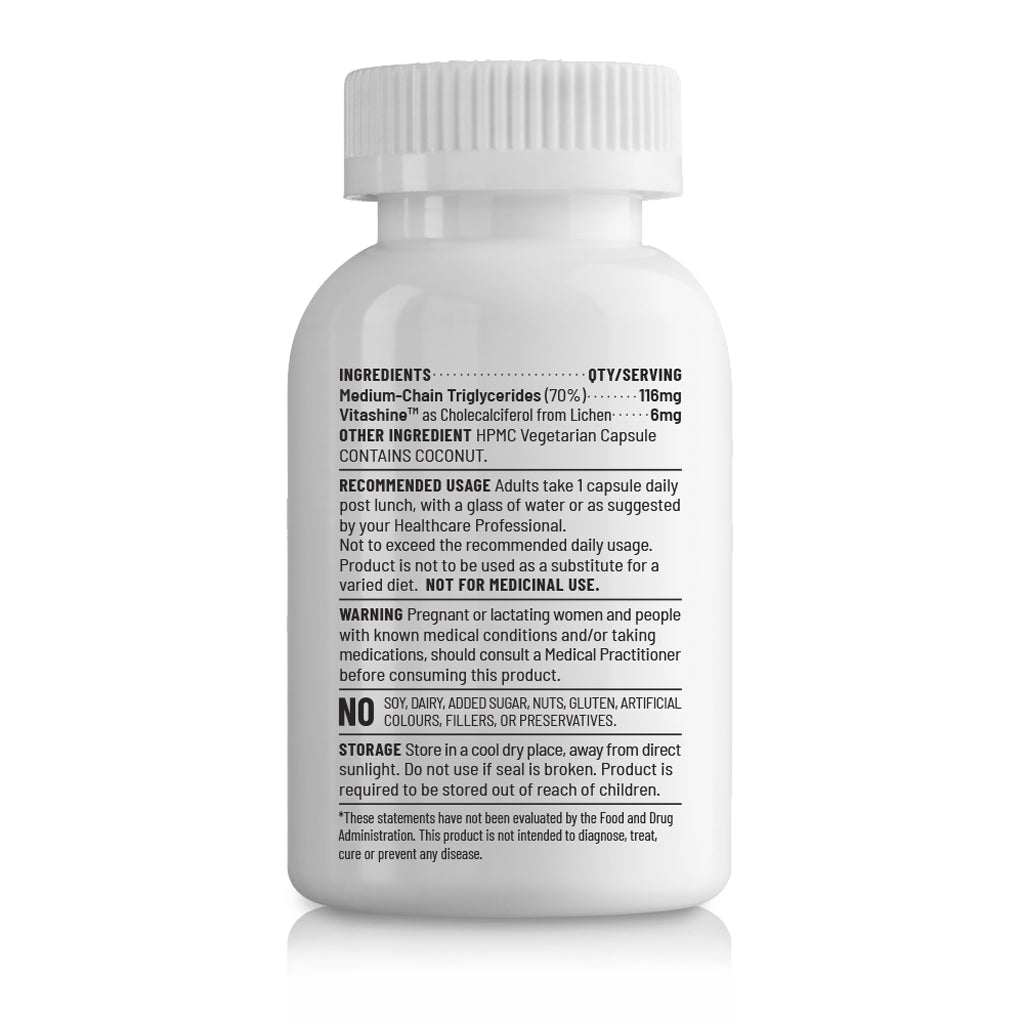
Vegan D3 is the simplest formulation in the D3 line — just 600 IU D3 with MCT carrier, in a 180-cap (6-month supply) pack. D3 + K2-7 adds 33.34mcg K2-7 to the same D3 dose, in a 90-cap pack — for adults who want K2-driven calcium direction alongside their D3. CalDveg® adds K2-7 (55mcg) plus 500mg calcium, 94mg magnesium, and 80mg amla Vitamin C — the full bone-mineral matrix for adults specifically targeting bone health. Choose Vegan D3 if you handle K2 separately or from food, want the simplest D3 formulation, and want the lowest per-capsule cost across years of daily use. Choose D3 + K2-7 for maintenance D3+K2 in one capsule. Choose CalDveg® if bone health is your specific target.
Why is Vitamin D3 in this product instead of D2?
D3 (cholecalciferol) is the form of Vitamin D the body produces from sunlight and uses directly. D2 (ergocalciferol) is a plant-source form that the body must convert to D3 before use — at lower efficiency. Most clinical research showing benefits of Vitamin D supplementation has used D3 specifically. For decades, vegan-suitable D3 was difficult to source (most commercial D3 is from lanolin, sheep's wool oil). Plant-source D3 is now available and is the preferred form for vegan supplementation — same molecular structure as lanolin-derived D3, same clinical effect, fully plant-derived.
Why does this contain MCT oil?
Vitamin D3 is fat-soluble — it absorbs significantly better when consumed with dietary fat. Most D3 products are dry capsules that depend on the customer remembering to take them with a fatty meal. The 81mg of MCT in each capsule serves as a built-in fat carrier — supporting absorption even when meals are light on fat. MCT specifically is used because it's the fastest-absorbing dietary fat, with no waiting for full digestion. This is a formulation decision, not a calorie addition — the 0.88 kcal per capsule is negligible.
Why is the MCT sourced from coconut — what if I have a coconut allergy?
Coconut is the most common commercial source of MCT (medium-chain triglycerides) because coconut oil naturally contains the highest concentration of C-8 (caprylic acid) and C-10 (capric acid) fatty acids — the specific medium-chain fats used in absorption-supporting formulations. If you have a coconut allergy, this product is not appropriate. The next-best D3 absorption strategy is to take a dry D3 capsule with a meal containing dietary fat from a different source (olive oil, ghee, nuts, eggs, full-fat plant milk, avocado).
I take a multivitamin that already has D3 — do I need this product too?
Depends on the dose in your multivitamin and your individual D3 status. Most multivitamins contain 200–600 IU of D3. If your multivitamin delivers 600 IU and your blood work shows your D3 status is in the normal range, you likely don't need additional D3 supplementation. If your multivitamin delivers less than 600 IU and you spend most of your day indoors, adding Vegan D3 brings your total daily intake into the maintenance range. If you have documented D3 deficiency, the standalone product allows higher therapeutic dosing under physician guidance without escalating your full multivitamin dose. Test your 25-OH Vitamin D blood level if uncertain — it's the most useful single piece of information for this decision.
How long before I see results?
Depends on what you're measuring and where you started. If your Vitamin D status was already adequate, the 25-OH D blood test will show your level holding steady — daily maintenance is doing its job. If you were sub-adequate but not deficient, the level may rise modestly over 8–12 weeks into the comfortable range. If you were deficient at baseline, the 600 IU maintenance dose is unlikely to fully correct the deficit on its own — your physician may prescribe a higher therapeutic dose first, with this product taking over for maintenance afterwards. Felt effects (energy, mood, muscle function) vary widely and are not reliable indicators of D3 status — the blood test is. Re-test after 8–12 weeks to confirm where you are.
Is this safe to take during pregnancy and breastfeeding?
Yes, generally — and D3 supplementation is actively recommended for most pregnant and lactating women. D3 is critical for foetal bone development, and breast milk D3 content reflects maternal intake. Some physicians recommend 1000–2000 IU daily during pregnancy and lactation; the 600 IU dose in this product is appropriate baseline supplementation. Confirm total daily intake with your gynaecologist — your prenatal vitamin may already contain D3.
Why 600 IU specifically? Is that enough?
600 IU is the Indian RDA for adults — calibrated for daily maintenance of normal D3 status. For adults with adequate sun exposure or normal blood D3 levels, this dose maintains status indefinitely. For adults with documented deficiency, higher doses are typically required for correction — your physician may recommend 2,000–5,000 IU daily for several weeks, or 60,000 IU weekly, until blood levels normalise, then stepping down to a maintenance dose like this product provides. The 600 IU dose is not "low" — it's "calibrated to maintain," which is what most adults need most of the time.
What does the 180-capsule pack signal — should I choose a smaller pack first?
The 180-capsule pack is calibrated for adults who have decided D3 supplementation is a long-term daily habit — typically vegans, vegetarians, or anyone with documented low D3 status. The per-capsule cost is meaningfully lower than in smaller packs. If you're new to D3 supplementation and want to commit one or two months at a time before going to a larger supply, smaller pack options are available. If you've already established this is a daily habit and know you'll use a 6-month supply, this is the lower-cost option.
Can I take this with my other Unived products?
Generally yes, with one consideration. Multiple Unived products contain D3 — Essential Protein, Elite Performance Protein, D3 + K2-7, CalDveg®, COLOX®, and the Multivitamins. If you stack two or three D3-containing products, you're likely doubling or tripling the 600 IU baseline — generally still within safe limits (the daily safe upper limit for D3 from supplements is typically considered 4,000 IU for healthy adults), but worth calculating. The right pattern is to pick the products that fit your stack and avoid stacking products that already deliver the same nutrients.