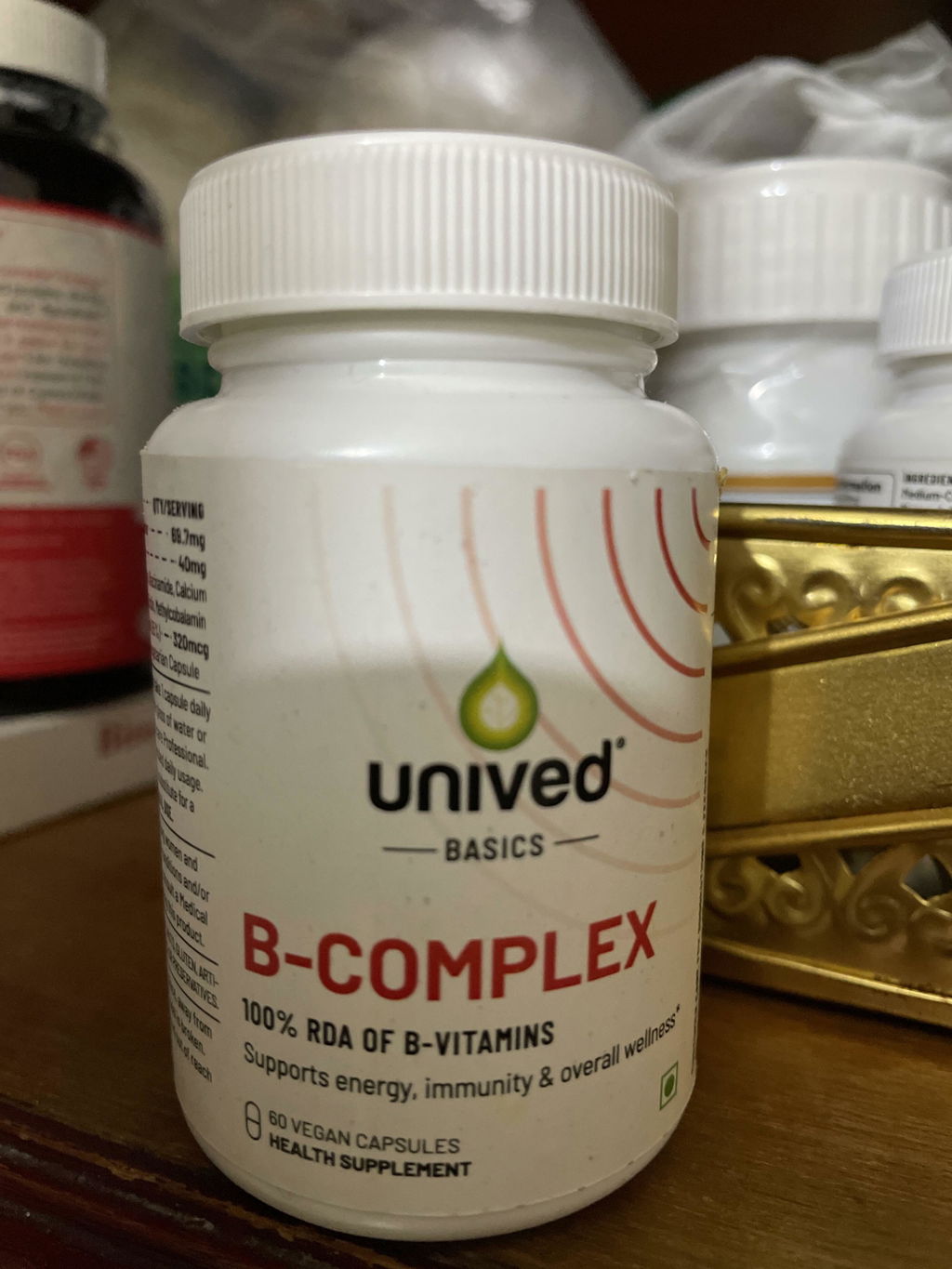
Who actually benefits from a B-complex?
The clearest cases are vegans and vegetarians (vitamin B12 is genuinely hard to get from a plant diet), people who eat irregularly or drink alcohol regularly, those under sustained stress, and anyone who converts folic acid poorly. Honest answer: if you eat a varied omnivorous diet and feel well, you may already get enough — a B-complex is most valuable for closing a specific gap rather than as a blanket daily boost.
What's special about the “methylated” forms?
Folate here is L-5-Methyltetrahydrofolate (methylfolate) and B12 is methylcobalamin — the active forms your body uses directly. Many people carry common MTHFR gene variants that make converting ordinary folic acid into usable folate inefficient; methylfolate skips that conversion. Methylcobalamin is likewise the active, circulating form of B12. It's the main reason to choose this over a cheaper folic-acid / cyanocobalamin formula.
Is the B12 vegan, and is methylcobalamin better?
Yes — the B12 is fully vegan (synthesised by fermentation, no animal source) and supplied as methylcobalamin, the active form. B12 is the single most important supplement for anyone on a long-term vegan or vegetarian diet, because reliable B12 simply isn't present in plant foods.
Why take it on an empty stomach?
B-vitamins are water-soluble and absorb well without food, so an empty stomach — first thing in the morning or between meals — maximises uptake. If it causes any mild nausea, take it with a small snack; the drop in absorption is minimal.
Why is my urine bright yellow after taking it?
That's riboflavin (vitamin B2), which is naturally bright yellow. Any amount beyond what your body uses that day is excreted, tinting your urine. It's completely harmless and is actually a visible sign the capsule dissolved and absorbed.
Will it give me energy?
Honestly — it removes a brake rather than adding a stimulant. The B-vitamins are cofactors in energy metabolism, so if you were genuinely short on them, correcting that can reduce fatigue. But it contains no caffeine or stimulants, and it won't create extra energy in someone who's already well-nourished.
Why niacinamide instead of niacin?
Niacinamide delivers vitamin B3 without the niacin flush — the temporary warmth, tingling and redness that nicotinic acid can cause. It's the same vitamin, in the more comfortable form.
Can I take it alongside my multivitamin?
Check for overlap first. If your multivitamin already provides 100% RDA of the B-vitamins, you generally don't need both every day. If you do combine them, add up the totals and keep them near RDA — particularly for B6, where sustained high intake is best avoided.
Does it contain any allergens?
No — it's free from soy, dairy, added sugar, nuts, gluten, artificial colours, fillers and preservatives. Worth noting it is soy-free, unlike the whole-food multivitamins (whose vitamin E is soya-derived), which makes this a good B-vitamin option for people avoiding soy.
There's moringa in it — why?
Organic moringa leaf powder is used as a clean, whole-food base that carries co-occurring micronutrients and plant compounds alongside the standardised B-vitamins. To be straight about it: the defined 100% RDA dosing is what does the work; the moringa is a plant-based carrier, not the active ingredient.