What's the difference between Complete Protein and Essential Protein?
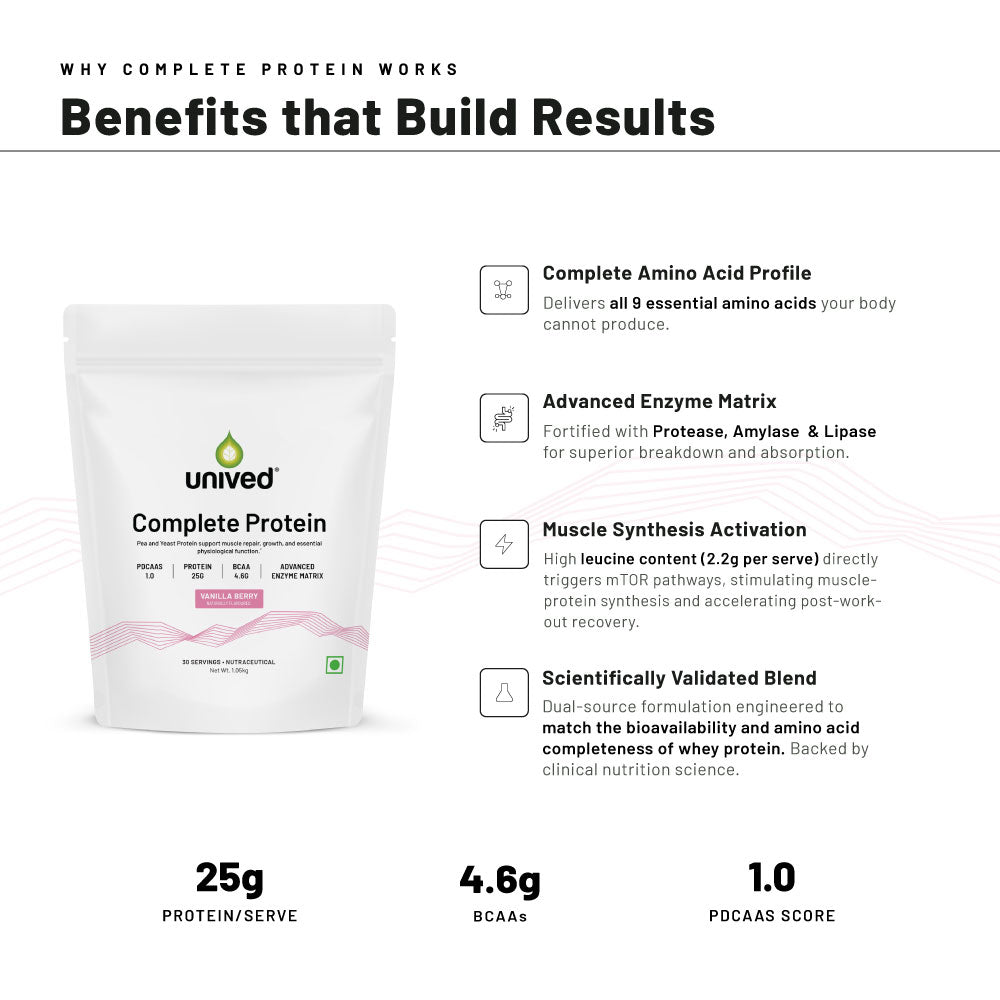
Both are pea + yeast formulations with complete amino acid coverage. Complete Protein is the fuller version — 25g protein per serving, full enzyme matrix, complete amino acid disclosure, designed for adults who have made daily protein supplementation part of their routine. Essential Protein is the entry-tier version — accessible price, simpler formulation, for adults trying daily protein supplementation for the first time or who want a lower-commitment option. Both work; both are PDCAAS 1.0.
What's the difference between Complete Protein and the Sports range protein products?
Complete Protein is positioned for everyday adult use — daily protein supplementation alongside food, not training-specific. The Sports range (Elite Performance, Elite Rebuild, Elite Endurance) is calibrated for active training contexts — different protein-to-carb ratios, added performance actives like creatine and electrolytes, formulated around specific moments in a training week. If you train recreationally or don't train but want reliable daily protein, Complete Protein is the right tool. If you train seriously, the Sports proteins are more targeted.
What is PDCAAS 1.0 and why does it matter?
PDCAAS — Protein Digestibility Corrected Amino Acid Score — is the standard measure of protein quality, combining amino acid completeness and digestibility into a single score. 1.0 is the maximum. Whey, casein, and eggs score 1.0; pea alone is around 0.7–0.9 because of the methionine gap; pea + yeast together reaches 1.0. The score matters because at 1.0, every gram of protein from the supplement is being utilised efficiently by your body.
What does the Advanced Enzyme Matrix actually do?
It addresses the GI challenges most plant proteins cause. Alpha Galactosidase breaks down the legume oligosaccharides that cause bloating and gas. Acid Protease and Neutral Protease support protein digestion. Phytase breaks down phytic acid that would otherwise bind minerals like iron and zinc. Glucoamylase and Fungal Alpha Amylase support starch breakdown. Together, the six enzymes mean Complete Protein digests comfortably even for adults who have abandoned plant proteins because of GI issues.
Is pea protein really comparable to whey protein?
Yes — and the research has converged on this in the last decade. Whey is faster-absorbing and slightly higher in leucine, which gave it an edge in older studies. Pea + yeast protein blends, which close the methionine gap and deliver complete amino acid coverage, perform comparably to whey for muscle protein synthesis and recovery in head-to-head trials. For most adults choosing between them, the decision is about dietary preference, lactose tolerance, and environmental impact, not nutritional performance.
How much protein do I actually need per day?
Sedentary adults need 0.8–1.0g per kg body weight; active adults need 1.2–1.5g per kg; athletes and adults over 50 need 1.5–2.0g per kg. A 70kg active adult needs about 105g of protein daily. One serving of Complete Protein contributes 25g — about a quarter of that target. The rest comes from food. Most adults underestimate their protein needs and chronically under-eat protein, particularly vegetarians and adults eating mixed diets without a deliberate protein focus.
Do I need to take protein after training?
Less critical than the supplement industry has historically claimed. The "anabolic window" — the idea that you must consume protein within 30 minutes of training — has been substantially walked back by current research. What actually matters: total daily protein intake, spread across 3–5 servings of 20–40g each. Whether you take Complete Protein 30 minutes after training or 90 minutes after makes little measurable difference for most adults.
Can I use this for cooking or baking?
The chocolate-flavoured version is designed for drinking — best mixed in cold water, plant milk, or as a smoothie. For cooking and baking flexibility, the raw (unflavoured) versions of our protein range are better suited — they can be added to porridge, soups, dough, batter, and savoury preparations without flavour interference.
What about kidney health? I've heard high protein is bad for kidneys.
For adults with healthy kidneys, current research does not show that protein intake in the 1.0–2.0g/kg range causes kidney damage. The concern arose from research on adults with pre-existing kidney disease, where high protein loads can accelerate decline of already-compromised kidney function. If you have known kidney disease, consult your nephrologist before any protein supplementation. If you have normal blood work, protein intake at recommended levels is well-tolerated.
How should I store the product once opened?
Store in a cool dry place, away from direct sunlight. Use a dry scoop each time to avoid moisture exposure (which causes clumping and potential microbial growth). Properly stored, the product remains at full quality through the printed expiry date. Refrigeration isn't necessary but doesn't hurt.